Vintage Burberry Scarf Collector's Guide
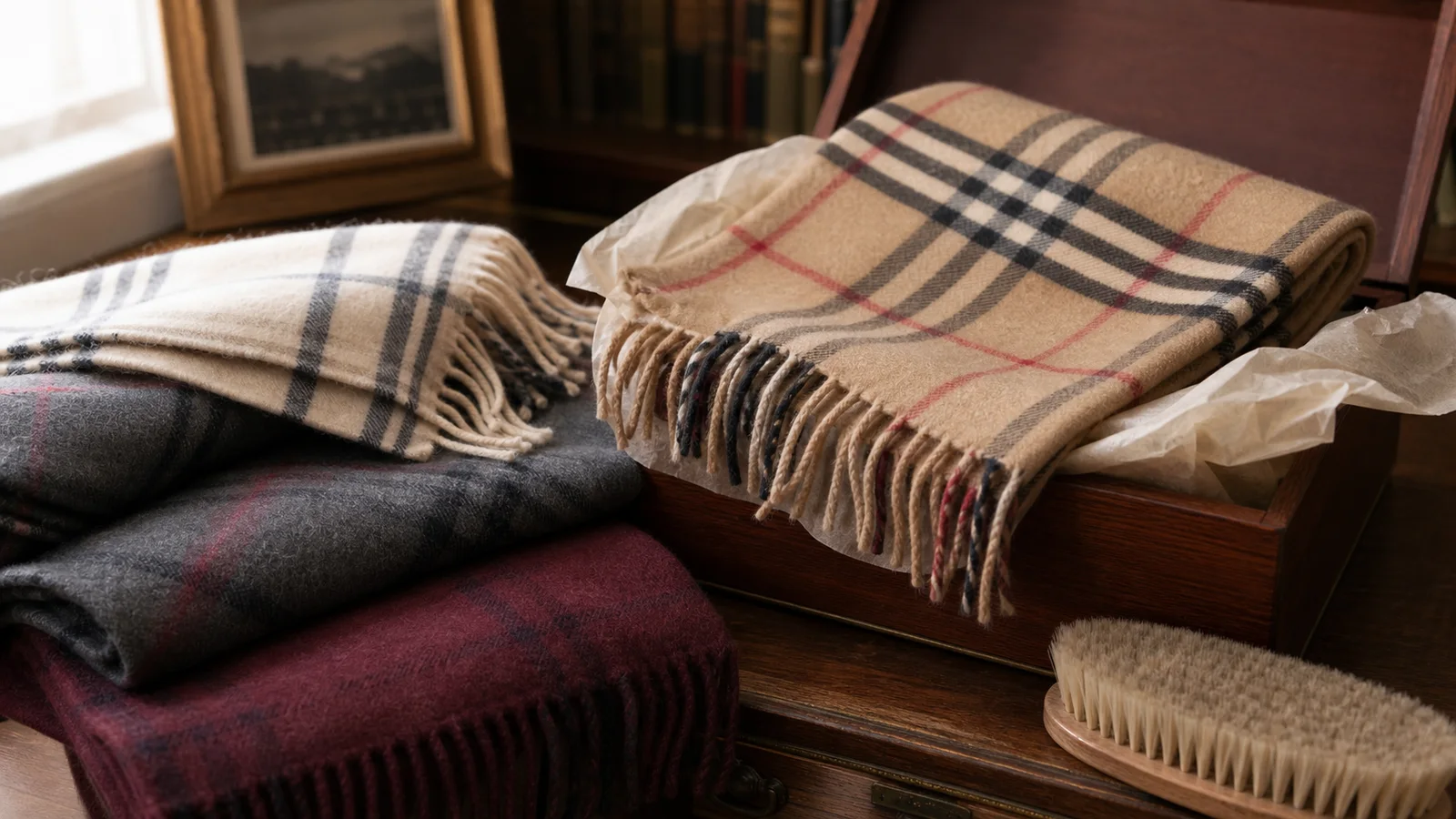
If you are new to vintage Burberry, a scarf is the single best starting point. The price range is accessible, the condition issues are visible and easy to assess, and a great vintage Burberry scarf will outlast and outperform almost any modern equivalent. This guide covers everything you need to know before buying.
Why Scarves Are the Best Entry Point
Vintage Burberry scarves offer:
- Lower entry cost than coats or bags while still being genuinely collectible.
- Wearable in any wardrobe — a Nova check scarf works with jeans and a t-shirt as easily as with a tailored coat.
- Easier condition assessment — you can see the entire piece without trying it on.
- Strong resale — quality pieces hold value well.
- Better quality than modern equivalents in many cases — older Burberry scarves were made with heavier yarn weights and denser weave structures than current production.
Materials: How to Identify from Label and Feel
Vintage Burberry scarves were made in several materials. The label usually states the fibre content, but knowing how to confirm by hand-feel is essential when buying without a label or from a seller who may not know what they have.
Lambswool: The most common material in vintage Burberry scarves. A sheep's-wool derivative that is softer than standard wool but coarser than cashmere or merino. Hand-feel: warm, slightly textured, dense. Label will read "100% lambswool" or "lambswool and nylon mix". Very durable — lambswool scarves from the 1970s and 1980s are usually still in excellent condition.
Cashmere: The premium tier. Cashmere comes from Kashmir goat undercoat — it is dramatically softer and lighter than lambswool with a silky, almost cloud-like hand-feel. Genuine cashmere has a particular warmth that is different in character from wool warmth — it feels lighter but more enveloping. Weight test: genuine cashmere scarves feel surprisingly light for how warm they are. Label will typically read "100% cashmere" or a blend like "cashmere and wool". Cashmere attracts moths — condition check accordingly.
Merino wool: Softer than standard lambswool, finer fibre. Warm but with less of cashmere's luxurious drape. Often used in thinner-knit and lighter scarves. Usually clearly labelled.
Silk and silk blends: Less common in vintage. Silk Burberry scarves tend to be lighter, more colourful, and often feature different pattern applications. The Nova check on silk has a distinctive sheen and drape entirely different from the wool versions.
Blended fibres: Many vintage Burberry scarves use wool/nylon or wool/acrylic blends. These are durable and affordable but lower on the collector scale. A nylon or acrylic component will slightly reduce the softness and change the hand-feel toward slightly scratchy.
Check Patterns: Nova Check, Haymarket Check, House Check
Not all Burberry check scarves are Nova check:
- Nova check: The classic four-colour camel/black/red/white tartan. Most common and most recognised.
- Haymarket check: A larger-scale, more muted tartan with different proportions. Genuine Burberry — look for the label.
- House check: A term sometimes used for the Haymarket pattern or for solid-coloured scarves with a check border. Can be confusing — rely on the label.
- Solid scarves with check edges: Legitimate Burberry product. A solid camel or grey scarf with a Nova check edge trim is a genuine vintage piece.
Fringe: Hand-Rolled vs Machine vs Cut
The fringe at each end of a Burberry scarf is a quick quality and authenticity signal:
- Hand-rolled or hand-knotted fringe: Found on better-era and higher-tier pieces. Each fringe strand is individually finished. Look closely and you will see slight variations between strands — the sign of handwork.
- Machine fringe: More uniform and regular. Still authentic — used on mid-tier pieces. Not a problem unless you specifically want the most premium examples.
- Cut fringe: Simply cut threads with no finishing. Found on the most basic versions. Frays more quickly over time.
- Fringe condition: Check for missing fringes (easy to spot), tangled or matted fringe (fixable), and fringe staining (sometimes irreversible). Fringe at scarf ends often shows first-generation wear.
Dating Vintage Burberry Scarves
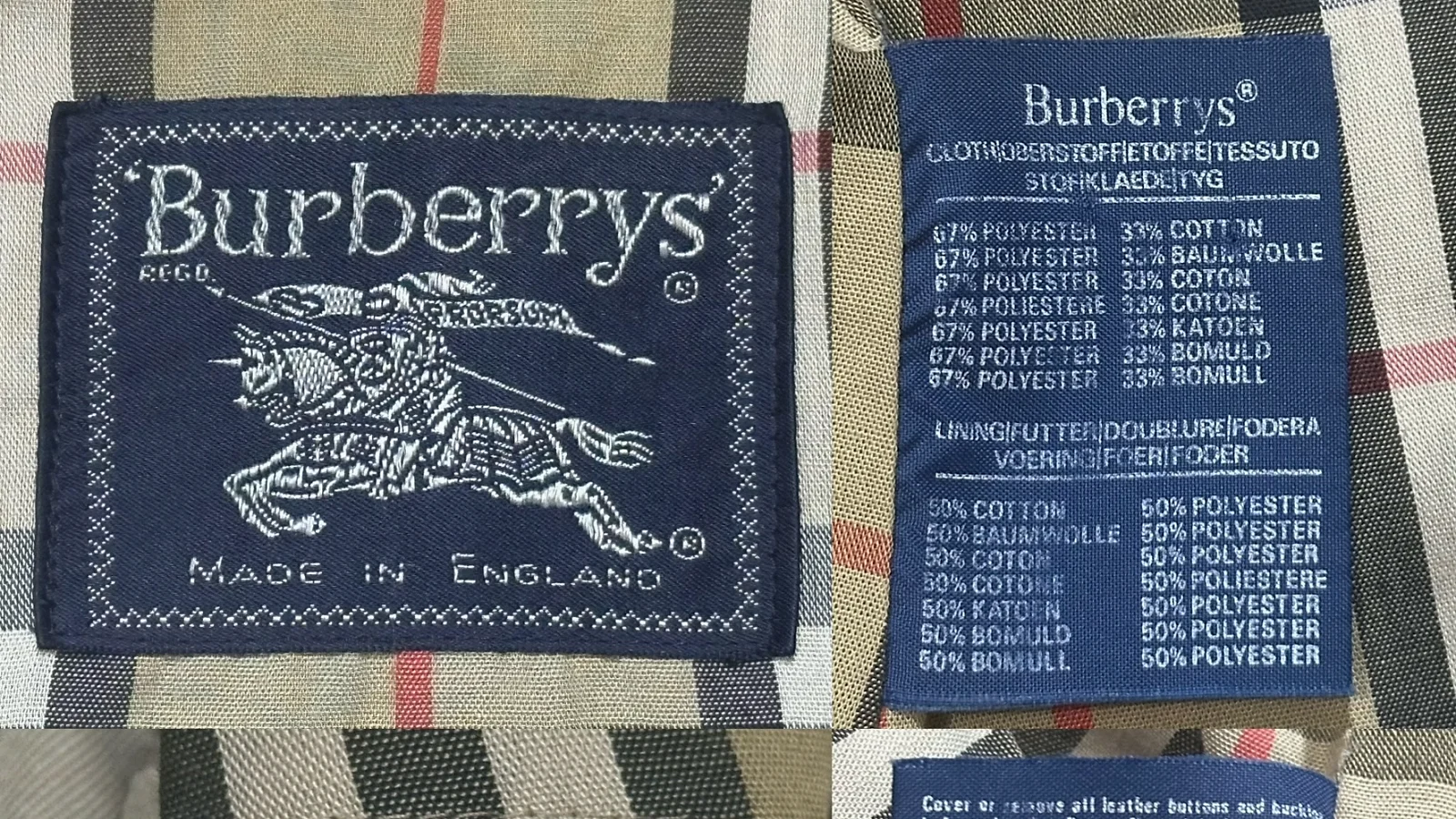
Label changes in scarves mirror the garment line (as detailed in our label dating guide):
- "Burberrys" or "Burberrys of London" on the inner label: pre-1999.
- "Burberry" without the possessive s: 1999 onward.
- Care symbols: present from the early 1970s on UK market scarves.
- No country of origin: generally pre-late-1960s.
- "Made in England": strongest from 1970s to mid-1990s.
- "Made in Scotland": some higher-end lambswool and cashmere pieces, consistent with Scotland's textile tradition.
Standard Sizes
Vintage Burberry scarves come in a range of sizes:
- Long scarf (standard): approximately 150–180 cm long, 30–35 cm wide. The classic drape-and-wrap scarf.
- Extra-long / oversized: Some vintage examples exceed 200 cm — these are the most versatile for multiple wrapping styles.
- Wide wrap / stole: Wider than 40 cm, often worn folded over the shoulders. Particularly common in cashmere pieces.
- Pocket square: 40–50 cm square. Rare but collectible.
Always confirm exact dimensions — listings often just say "scarf" without specifying.
Condition Issues Specific to Scarves
Pulls and snags: Wool fibres can pull when caught on jewellery, velcro, or rough surfaces. Minor pulls can sometimes be eased back with a blunt needle. Significant pulling indicates the weave has been damaged.
Pilling: Small fibre balls on the surface, particularly in high-friction areas (where the scarf contacts coat fabric). Light pilling is normal and removable with a cashmere comb or fabric shaver. Heavy pilling indicates significant wear.
Moth holes: The enemy of natural-fibre vintage. Tiny irregular holes, often in clusters. On a patterned scarf, small holes in the ground colour can be very difficult to see — ask the seller specifically. Smell test is useful: moth-damaged wool often has a slightly distinctive musty scent different from normal aged wool.
Stains: Common near the ends that contact food and drink. Assess size, type, and age of stain. Old set stains may be permanent; recent stains from clean liquids often respond to careful washing.
Fading: UV-caused colour fading, most common in pieces that were displayed or stored in light. The camel ground typically fades soonest.
The Sniff Test
Experienced vintage buyers know their nose:
- Aged wool smell: A mild, dry, slightly lanolin-tinged scent. This is normal and will wash out. Not a concern.
- Musty/damp smell: Indicates poor storage conditions, possibly moisture damage or mould. Can be treated but varies in severity.
- Moth treatment smell: Strong chemical smell indicating the piece was treated with mothballs. This smell can take months to fully dissipate.
- Smoke smell: Penetrated fabric fibres. Very difficult to remove fully.
- Clean: Ideal — the piece has been properly stored and possibly freshly cleaned.
Care: How to Wash and Store Vintage Scarves
- Cashmere: Hand wash in cold water with a specialist cashmere wash. Never hot water (causes shrinkage and felting). Never wring — press gently in a towel to remove water. Dry flat, never hang (hanging stretches cashmere permanently). Store folded in breathable storage with cedar (not mothballs — the scent penetrates).
- Lambswool and merino: Similar care to cashmere — cool water, gentle wash, flat dry. Can tolerate slightly warmer water than cashmere without damage.
- Silk: Dry clean only for vintage pieces unless you are very confident in your technique.
Why Vintage Beats Modern
Many vintage Burberry scarves — particularly lambswool and cashmere examples from the 1970s through 1990s — are demonstrably heavier and more densely woven than current production of comparable price points. Modern luxury scarves have in many cases become lighter and thinner as margins are squeezed. The vintage pieces offer more raw material and more hand-finishing per pound of cost.
Our shop carries a curated selection of vintage Burberry scarves, each with fibre content, dimensions, condition notes, and label photographs. Browse the current selection.