The Complete Guide to Vintage Burberry
Vintage Burberry is easiest to understand as a system: weatherproof cloth, functional outerwear, evolving labels, licensed regional lines and one of fashion’s most recognisable checks. This page is the starting point. Use each section for the essentials, then follow the specialist guides when you need to date or assess a particular piece.
Start here: history · labels · the check · what to buy · authentication · care
A Five-Minute History
| Year | Official Burberry milestone | Why it matters to collectors |
|---|---|---|
| 1856 | Thomas Burberry establishes the business in Basingstoke | The beginning of the house |
| 1879 / 1888 | Gabardine is invented, then patented | The technical cloth behind Burberry outerwear |
| 1912 | The Tielocken coat is patented | A predecessor of the trench coat |
| 1914–1918 | Burberry supplies military apparel and equipment | Functional trench details become part of the design language |
| 1920s | The Burberry Check is introduced as rainwear lining | The house code begins inside the coat |
| 1967 | Check accessories emerge from a Paris presentation | The lining moves outward into visible products |
| 1999 | The company name changes from Burberrys to Burberry | A major label-dating boundary |
| 2016/17 | Prorsum, London and Brit transition to one Burberry label | Explains later simplified labels |
Burberry’s official history dates the invention of gabardine to 1879 and its patent to 1888. Keeping those two events separate is useful: many summaries collapse them into one date.
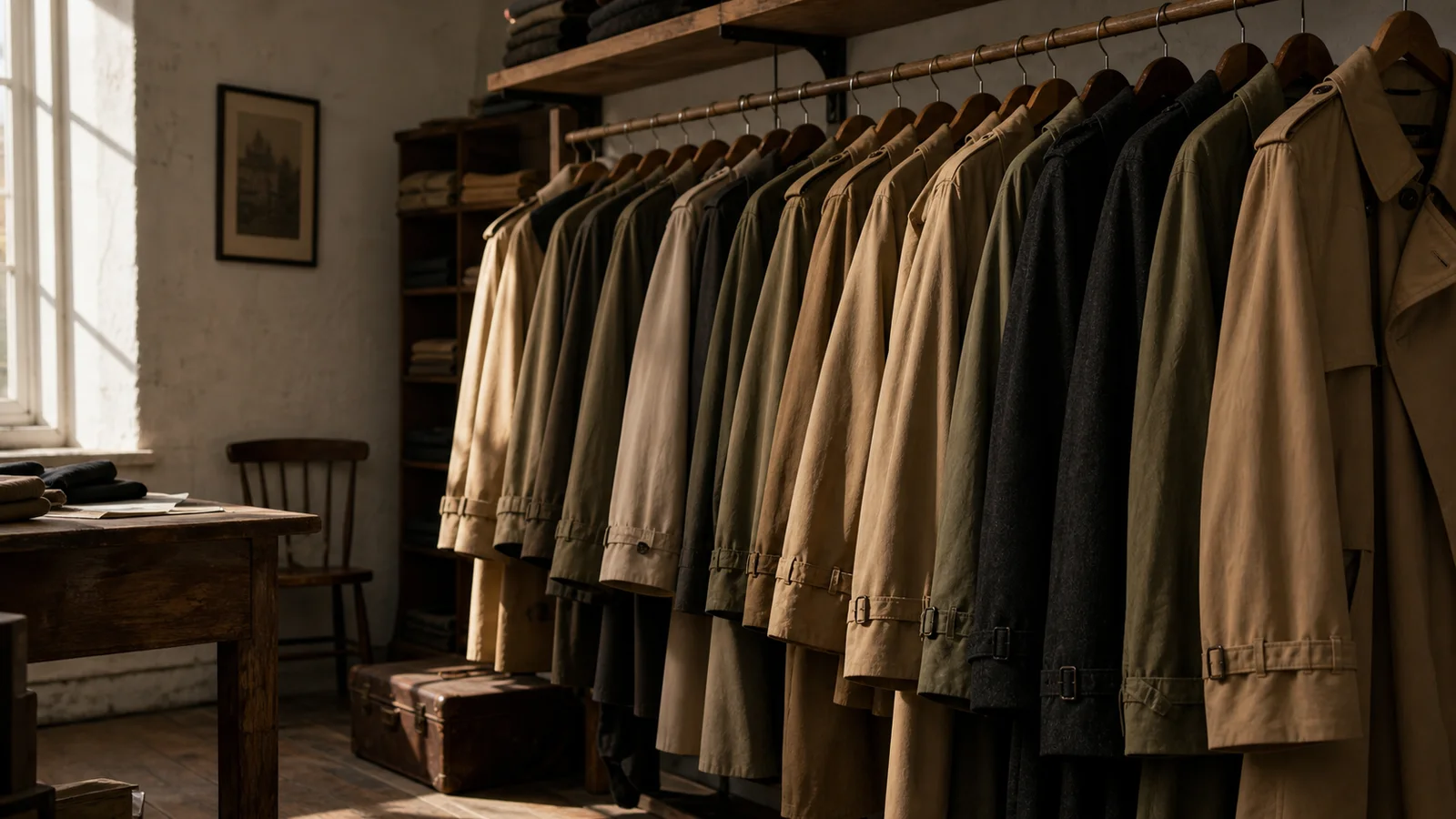
That fabric story leads directly to the garment most collectors associate with the house. The patented Tielocken coat of 1912 established a belted, weather-resistant outerwear form; Burberry’s First World War military supply then placed practical details such as storm protection, straps and robust closures into the wider trench-coat story. Surviving vintage coats should still be judged by their individual pattern and date rather than being described generically as wartime pieces.
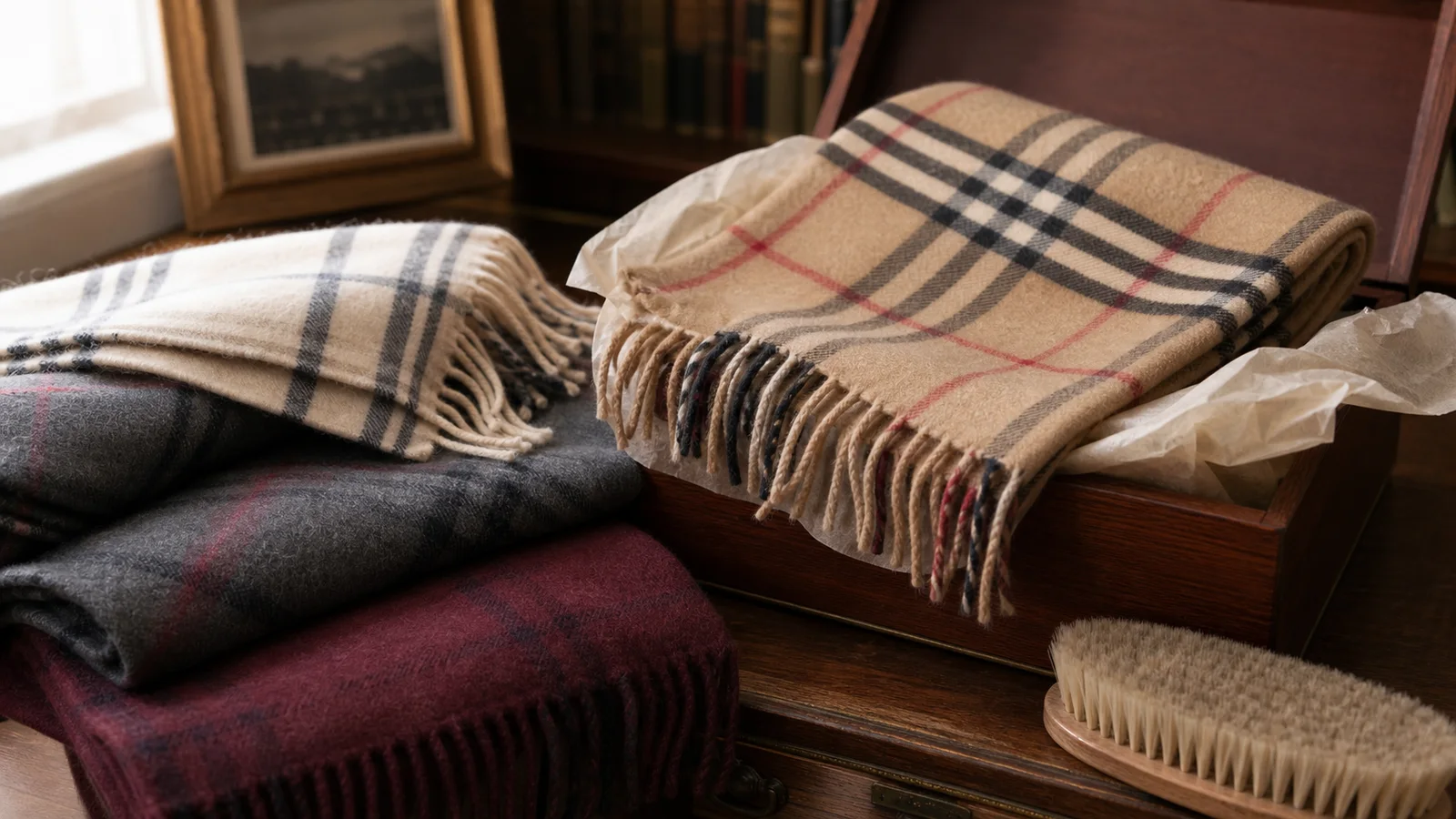
The Check arrived later than the outerwear technology. Burberry records it as a rainwear lining from the 1920s, before the 1967 Paris presentation helped move the pattern from the inside of coats into visible accessories. That progression—from technical cloth, to functional coat, to recognisable house code—explains why cloth, construction and lining all matter when assessing vintage Burberry.
Labels and Dating
The most common question is also the simplest:
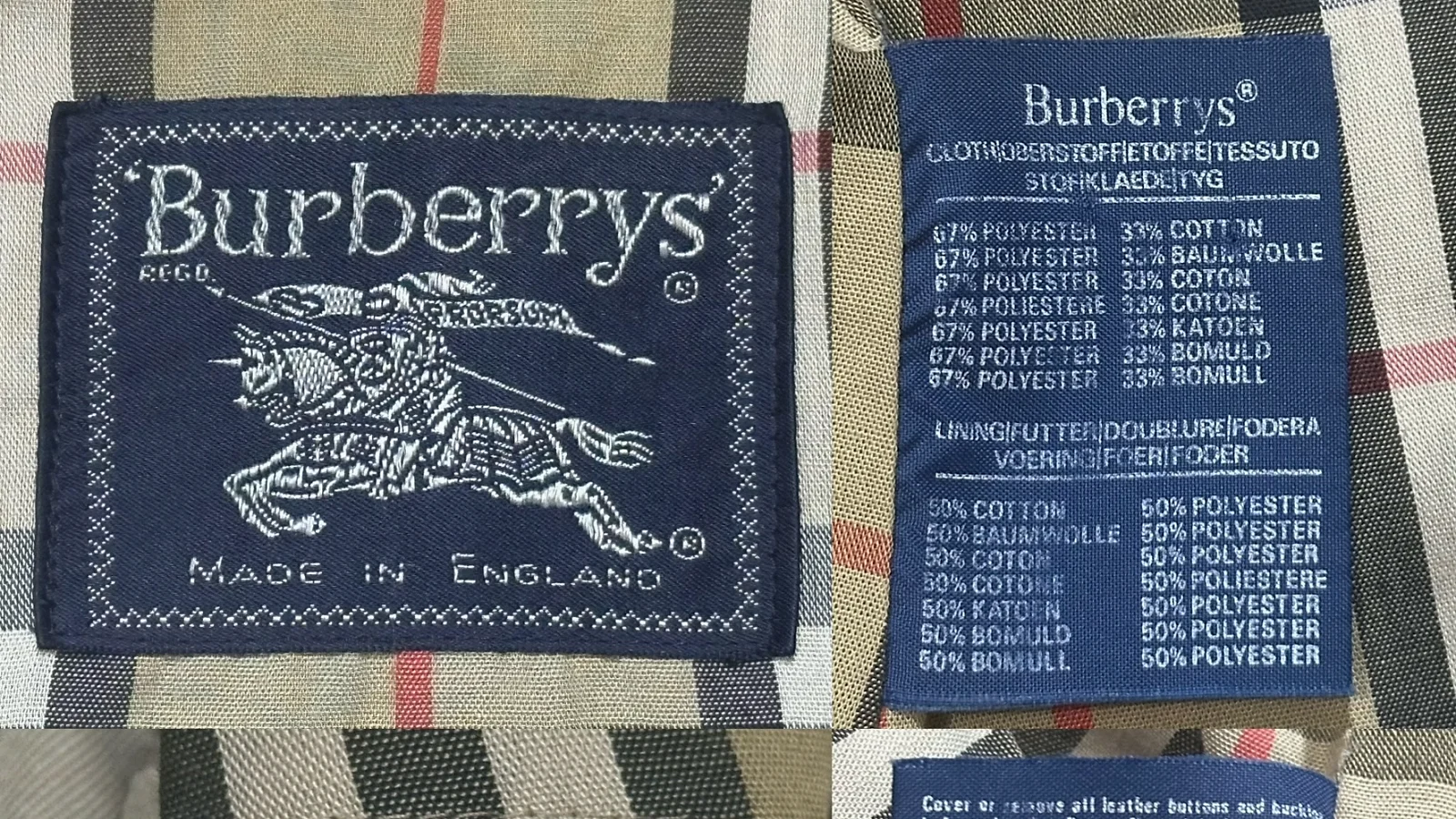
Is “Burberrys” genuine? Yes. The company officially changed its name from Burberrys to Burberry in 1999. The trailing s is a useful pre-1999 clue, not evidence of a fake.
The main label gives you a starting range:
- Burberrys / Burberrys of London: usually consistent with the period before the 1999 name change.
- Burberry / Burberry London: consistent with the post-name-change period.
- Prorsum, London or Brit: also identifies a collection within the 2000s-to-mid-2010s structure.
- Blue Label or Black Label: Japan-licensed lines launched by Sanyo Shokai in 1996 and 1998.
Do not stop at the front label. Cross-check care instructions, fibre composition, country of origin, distributor information, construction and any product codes. A transferred label can look convincing in isolation.
For the full evidence method, use the Burberry label dating guide. For Japan-market pieces, continue with the Blue Label vs Black Label guide.
The Burberry Check
Burberry’s official timeline places the Check’s introduction as a rainwear lining in the 1920s. In 1967, a Paris-store buyer used check lining to wrap luggage and make an umbrella cover for a presentation; this is the company’s own milestone for check accessories moving outward.
“Nova Check” is widely used in the vintage and resale market, while Burberry’s current corporate material generally calls the house code the Burberry Check. Terminology alone does not authenticate a piece.
When assessing check fabric, examine:
- colour and stripe consistency across the whole garment;
- how the pattern meets at major seams and pockets;
- weave, fibre content and print quality;
- whether the check use makes sense for that product line and period.
Perfect alignment is not a universal one-step test across every garment, accessory and construction method. It is one piece of evidence.
Read the detailed Nova Check authentication guide.
What to Look for When Buying
| Category | Inspect first | Common buying risk |
|---|---|---|
| Trench or car coat | Measurements, gabardine, lining, belt and removable parts | Missing components, hidden odour, alterations |
| Wool or cashmere coat | Composition, moth damage, lining and shoulder shape | Small repaired holes or distorted storage |
| Scarf | Fibre label, dimensions, fringe and surface wear | Moth damage, felting, undisclosed repairs |
| Shirt or knitwear | Measurements, collar/cuffs, pilling and care label | Size assumptions based only on the tag |
| Japan-licensed line | Full Blue/Black Label wording and Japanese care label | Mislisting Crestbridge as Burberry |
For coats, request actual chest, shoulder, sleeve and back-length measurements. Vintage size labels are not a reliable conversion chart. Read the vintage Burberry trench coat buying guide before committing to a coat online.
For scarves, compare fibre, fringe, dimensions and condition with the vintage Burberry scarf collector’s guide.
Authentication: Stack the Evidence
No single “hack” authenticates every vintage Burberry product. Build a case:
- Identity: Does the exact label belong to a known line and period?
- Supporting labels: Do care, composition, distributor and origin details agree?
- Materials: Are the fibre and fabric appropriate to the claimed product?
- Construction: Do seams, lining, pockets and hardware make sense together?
- Condition and alterations: Could a label, lining, button set or component have been replaced?
- Provenance: Does the seller provide clear photographs, measurements and a coherent description?
If one clue conflicts, investigate rather than explaining it away. Also avoid the opposite mistake: one unusual feature does not automatically prove a fake, because export markets, licensed lines, repairs and production changes create legitimate variation.
Care and Storage
- Read the original care label before cleaning.
- For structured coats, use a broad hanger and give the garment space.
- Isolate and inspect wool or cashmere for moth activity before adding it to a wardrobe.
- Do not aggressively machine-wash a vintage trench or assume every gabardine treatment can be restored at home.
- Store scarves clean and dry, with folds changed occasionally to avoid permanent creasing.
When in doubt, use a cleaner experienced with vintage structured outerwear and disclose any existing repairs.
Continue Your Research
- Date a Burberry label
- Compare Blue Label and Black Label
- Buy a vintage trench coat
- Assess Nova Check
- Collect vintage Burberry scarves
- Style vintage Burberry
Sources and Further Reading
- Burberry corporate history — official milestones for gabardine, the trench, the Check and the 1999 name change.
- Burberry 2015/16 Annual Report — unification of Prorsum, London and Brit.
- Burberry 2013/14 preliminary results — Japan licence transition.
- Sanyo Shokai’s 2015 Crestbridge announcement — Blue/Black Label launch dates and successor brands.
Browse the current vintage Burberry collection — or submit a Wanted request for a particular style, era or size.