Burberry Label Dating Guide: How to Identify Every Era
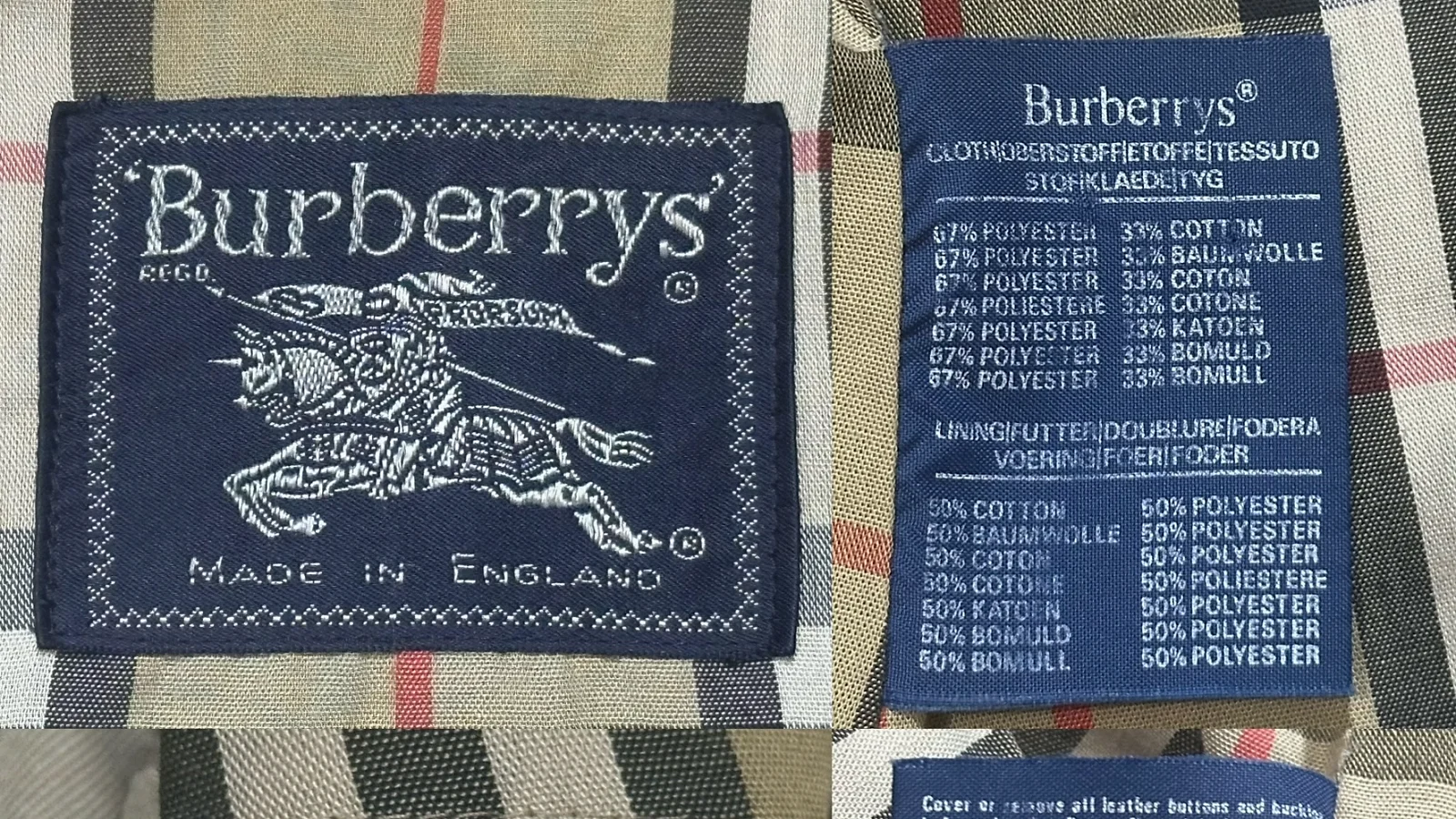
A Burberry label is a powerful dating clue, but it is not a complete authentication verdict. The safest method is to combine the main woven label with the care label, country of origin, product line, construction and any traceable product codes. This guide separates what a label can prove from what it can only suggest.
In this guide: quick chronology · how to read the evidence · Japan labels · buyer checklist
The short answer: “Burberrys” is not a misspelling or an automatic fake. Burberry officially changed the company name from Burberrys to Burberry in 1999. Treat that date as a strong boundary, then verify the rest of the garment.
Quick Chronology
| Label or marker | Broad period | What it tells you |
|---|---|---|
| Burberrys / Burberrys of London | Usually before the 1999 name change | A useful pre-1999 clue, not a decade on its own |
| Burberry / Burberry London | 1999 onward | Consistent with the post-name-change period |
| Burberry Prorsum / London / Brit | Mainly 2000s to mid-2010s | Identifies a product line as well as an era |
| Single Burberry label after the three-line system | Transitioned during 2016/17 | Can pre-date Riccardo Tisci’s 2018 appointment |
| Burberry Blue Label / Black Label | Japan-licensed labels before the 2015 transition | Authentic licensed product, distinct from the global main line |
| Blue Label Crestbridge / Black Label Crestbridge | Launched in 2015 | A successor brand, not Burberry-branded product |
This chronology is deliberately broad. Labels were used across seasons, export markets and product categories, so a five-year date should never be claimed from the main label alone.
How to Read the Evidence
Start with the main label, then move outward:
- Exact wording: Record every word, including “London”, “of London”, “Prorsum”, “Brit”, “Blue Label” or “Black Label”.
- Typography and weave: Compare letter shapes, spacing, edge finishing and the clarity of the Equestrian Knight Design where present.
- Care and composition label: Fibre content, care language and distributor information often tell you more than the front label.
- Country of origin: Useful as a cross-check, but Burberry has produced in multiple countries. “Not made in England” does not automatically mean fake.
- Product line: A Prorsum runway piece, a global London piece and a Japan-licensed Blue Label piece should not be judged by one identical construction template.
- Construction: Buttons, buckles, lining, pockets and seam finishing must make sense together.
RN or other company-registration numbers can help identify the business responsible for a US-market label, but they are not serial numbers and do not by themselves reveal the year a garment was made.
Before 1999: Understanding “Burberrys”
Burberry’s own corporate history records the company-name change from Burberrys to Burberry in 1999. That makes the trailing s one of the most useful high-level dating markers in the vintage market.
Within that long pre-1999 period, collectors commonly encounter three broad groups:
- Early woven labels: “Thomas Burberry”, “Burberrys” and other sparse woven labels can appear on older pieces. Genuine pre-1960s garments are scarce, so the label must be supported by period construction and provenance; an old-looking weave is not enough.
- 1960s–1970s-style labels: “Burberrys of London” is strongly associated with the classic mid-century and later vintage market. Care symbols, union or retailer labels and country-of-origin wording may help narrow the range, but their introduction varied by destination and garment category.
- 1980s–1990s labels: More detailed care and composition labels become increasingly useful, and US-market garments may carry RN or WPL information. Heavier branded hardware and “Made in England” wording can support the assessment, but neither feature proves a decade by itself.
This earlier chronology is worth preserving because “Burberrys” spans far more than one era. It should be read as a sequence of changing label systems, not as a single pre-1999 category.
It does not mean that every “Burberrys” piece belongs to the same decade. The wording appears across many years and product types. To move from “pre-1999” to a narrower estimate, compare:
- the full label wording and crest;
- the care-label format and languages;
- country of origin;
- fibre content and lining;
- hardware and garment pattern;
- retailer, distributor or product codes.
Very early or unusually valuable claims deserve provenance. A simple old-looking label is not enough to establish a pre-war date.
1999 and the Post-Name-Change Labels
The official milestone is straightforward: the company name changed in 1999. Christopher Bailey joined Burberry later, in 2001 according to a Burberry corporate biography (the current company timeline lists his Design Director appointment in 2002), so the 1999 name change should not be attributed to him.
Labels reading Burberry or Burberry London fit the post-1999 period. Allow for transitional stock and different product categories rather than treating 1 January 1999 as a factory cut-off date.
Prorsum, London and Brit
During the 2000s and first half of the 2010s, labels also identify the collection:
- Burberry Prorsum: runway and fashion-led collection.
- Burberry London: the principal tailored and ready-to-wear offer.
- Burberry Brit: casual collection.
Burberry’s 2015/16 annual report states that Prorsum, London and Brit were being unified under one Burberry label, with the transition phased during 2016/17. A plain Burberry label therefore does not automatically mean “2018 or later”; the simplification began before Riccardo Tisci was appointed in 2018.
Japan-Licensed Labels
Sanyo Shokai developed Burberry-labelled collections specifically for Japan. Its own 2015 announcement records Burberry Blue Label launching in 1996 and Burberry Black Label in 1998. These are licensed Burberry products, but they are separate from the global main line in design, fit and distribution.
Look for:
- the complete Blue Label or Black Label wording;
- Japanese distributor and care information;
- the actual country-of-origin statement;
- measurements rather than assumptions based on the letter size.
The Burberry Japan licences expired on 30 June 2015. Sanyo then launched Blue Label Crestbridge and Black Label Crestbridge. Those successor labels continue the Blue/Black concept but should not be described or sold as Burberry.
Read the full Blue Label vs Black Label guide.
A Practical Seven-Point Check
Before assigning an era, photograph and record:
- Main woven label, straight on.
- Full care/composition label, front and back.
- Country-of-origin line.
- Any RN, distributor, style or product code.
- Buttons, buckles and zips.
- Lining and pocket construction.
- Full garment silhouette and measurements.
If one clue conflicts with the others, pause. A replaced label, altered lining, export-market variation or counterfeit are all possible; the contradiction matters more than any one “correct-looking” detail.
Sources and Further Reading
- Burberry corporate history — official 1999 name-change timeline and Christopher Bailey chronology.
- Burberry 2015/16 Annual Report — unification of Prorsum, London and Brit.
- Burberry 2013/14 preliminary results — Japan licence transition.
- Sanyo Shokai’s 2015 Crestbridge announcement — Blue/Black Label launch years and successor brands.
Browse the current Burberry collection — or tell us what you are looking for if a particular era, label or size is missing.