Burberry Blue Label vs Black Label: The Complete Guide
Burberry Blue Label and Burberry Black Label were genuine licensed lines created for Japan, not counterfeits and not the same product offer as Burberry’s global main line. The distinction matters because the labels, fit, design language and post-2015 successors are frequently misdescribed in the resale market.
In this guide: at a glance · how to identify them · fit and quality · the 2015 transition
Blue Label vs Black Label at a Glance
| Burberry Blue Label | Burberry Black Label | |
|---|---|---|
| Market | Japan | Japan |
| Original focus | Women’s contemporary line | Men’s contemporary line |
| Official launch | 1996 | 1998 |
| Licence operator | Sanyo Shokai | Sanyo Shokai |
| Burberry licence end | June 2015 | June 2015 |
| Successor | Blue Label Crestbridge | Black Label Crestbridge |
The 1996 and 1998 launch dates come from Sanyo Shokai’s own 2015 announcement, correcting the common but inaccurate claim that both labels date back to the 1970s.
What “Licensed for Japan” Means
Under a licence, Sanyo Shokai developed and sold Burberry-labelled products for the Japanese market. A licensed Blue or Black Label garment is therefore authentic within that historic licence, while remaining distinct from Burberry’s global collections.
That distinction is descriptive, not a judgement that one is automatically better. It tells you which market and product system the garment came from, and how it should be compared and priced.
“Made for the Japanese market” does not necessarily mean “made in Japan.” Burberry Blue Label and Black Label were historic licensed lines created for Japan, but individual garments may have been manufactured in Japan, Vietnam, China or elsewhere. Identify the line from the complete brand and Japanese care labels, and record the country of manufacture separately from the garment label.
Burberry Blue Label
Blue Label launched in 1996 as the women’s line. Vintage examples often lean towards a youthful Japanese interpretation of British styling: shorter proportions, fitted outerwear, skirts, knitwear, dresses, bags and accessories, with check used as lining, trim or an outward motif.
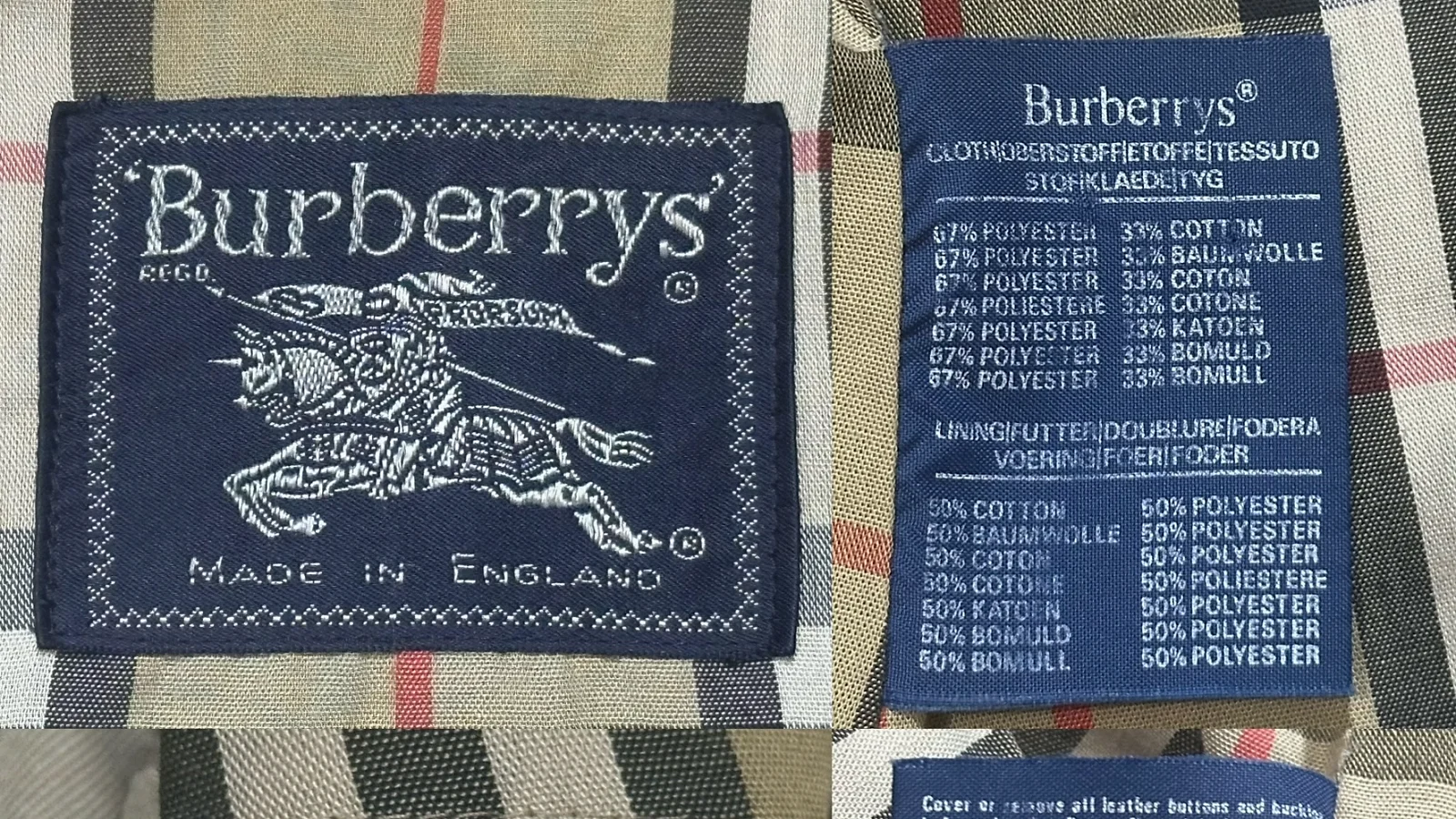
Do not authenticate it from the colour of the label alone. Confirm the complete Burberry Blue Label wording, then examine the Japanese care/distributor label, fibre content, stated country of origin and construction.
Burberry Black Label
Black Label launched in 1998 as the men’s line. Common categories include tailoring, shirts, knitwear, polos, trousers and outerwear. Cuts are often neater or slimmer than comparable British-market vintage clothing, but fit varies by season and garment.
Again, the words Burberry Black Label and the supporting Japanese label matter more than a seller calling something “black label” because the woven tag happens to be dark.
Thomas Burberry: A Less Familiar Japan-Market Line
Vintage buyers may also encounter Thomas Burberry, a less familiar Japan-market sports and casual line using the founder’s full name. Examples tend to include casual outerwear, knitwear, sports-influenced clothing and accessories rather than the clearer women’s Blue Label or men’s Black Label positioning.
Do not treat “Thomas Burberry” as another name for the global main line, or infer an early date merely because it uses the founder’s name. Read the supporting Japanese care and distributor labels, actual country of origin and construction in the same way as Blue or Black Label.
Do Not Confuse Them with Burberry Brit
Burberry Brit belonged to Burberry’s global collection structure alongside London and Prorsum; it was not the Japanese Black Label. Burberry’s 2015/16 annual report records that Prorsum, London and Brit were unified under one Burberry label during the 2016/17 transition.
Quick rule:
- Black Label: Japan licence, launched in 1998.
- Brit: global Burberry collection, later absorbed into the unified Burberry label.
How to Read the Labels
Ask for photographs of:
- The complete front woven label.
- Every page or side of the Japanese care label.
- Fibre composition.
- Country of origin — do not assume every Japan-market garment was physically made in Japan.
- Sanyo/distributor wording and any product code.
- Full garment, hardware and lining.
A correct-looking main label can be transferred. The supporting label and construction should tell the same story.
Use the full Burberry label dating guide when the garment also carries London, Prorsum, Brit or older Burberrys markings.
Fit, Quality and Value
Fit
Japanese-market letter sizes cannot be converted reliably with a single rule such as “Japanese L equals UK S”. Category, year and intended silhouette all matter. Use measurements:
- chest or pit to pit;
- shoulder width;
- sleeve length;
- back length;
- waist and rise for trousers or skirts.
Compare those numbers with a garment you already own. This is safer than automatically sizing up once or twice.
Quality
Judge the individual piece rather than the licence name. Check:
| General tendency | UK/global main line | Blue/Black Label Japan lines |
|---|---|---|
| Proportions | British or international sizing by market | Often shorter or slimmer for the intended Japanese market |
| Design language | Heritage, runway or global collection direction | A Japan-specific interpretation, often lighter or more youthful |
| Construction | Varies widely by line, category and year | Also varies widely; licensed does not mean counterfeit or automatically inferior |
| Best comparison | Same product line and period | Same Japan line, category and period |
- fibre content and fabric weight;
- lining and seam finishing;
- button and zip attachment;
- shape retention;
- pilling, moth damage, staining and alterations.
Blue/Black Label can include well-made wool, cashmere and tailored pieces, but the licence is not a universal quality grade.
Value
Price should reflect the actual garment: material, condition, design, rarity and fit demand. A Japan-licensed piece should be disclosed as such so the buyer can compare like with like. Do not pay a main-line premium simply because a listing hides or misunderstands the label.
What Changed in 2015
Burberry’s official results state that the Japan licences expired on 30 June 2015, with licensed Burberry product exiting the primary channel by September 2015.
Sanyo launched Blue Label Crestbridge and Black Label Crestbridge for Autumn/Winter 2015. Sanyo described them as successor brands, and its corporate history records both launches in 2015. They retained the Blue/Black identity under a new arrangement, but without Burberry branding.
For resale descriptions:
- Burberry Blue Label / Black Label: historic licensed Burberry product.
- Blue Label Crestbridge / Black Label Crestbridge: post-2015 successor brand; do not list it as Burberry.
Are They Worth Buying?
They can be, when the garment itself is right. Blue Label is particularly interesting for fitted womenswear and accessories; Black Label for compact tailoring, shirts, knitwear and outerwear. Buy for design, material, condition and measurements — not for the assumption that every licensed piece is rare or equivalent to the global main line.
Sources and Further Reading
- Sanyo Shokai’s 2015 launch announcement — official Blue/Black Label launch years and Crestbridge transition.
- Sanyo Shokai company history — records both Crestbridge launches in 2015.
- Burberry 2013/14 preliminary results — licence expiry and removal of licensed Burberry product.
- Burberry 2015/16 Annual Report — global Prorsum/London/Brit label unification.
Browse available Burberry Blue Label and Black Label pieces — or submit a Wanted request with your measurements and preferred label.